Change Language :
Correctly securing plain bearings
Causes of problems and solutions for perfect function
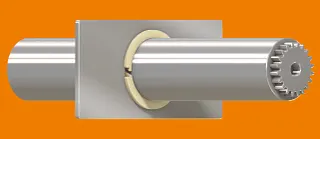
Plain bearings are crucial components in constructions with moving elements. However, even small errors when securing bearings can have serious consequences: unwanted noise, excessive wear or even complete failure of the bearing point. In the following, we will show you the most common causes of these problems, then provide you with suggested solutions and show you how to optimally secure plain bearings.
What you will find on this page

Why plain bearings "drift"
The so-called drifting is the reason why we secure plain bearings. But what does this term actually mean?
"Drifting" plain bearings lose their tight fit in the housing bore and move about even though they are supposed to be fixed. This problem often occurs when the press-fit - the mechanical tension that holds the bearing firmly in the hole - is insufficient. Causes for this can include:


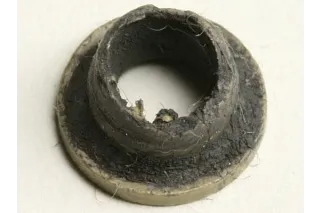
The consequences of "drifting"
Plain bearings, which rotate together with the shaft in the hole, wear out both the housing and themselves. This leads to unwanted noises or even total failures.
Prevent "drifting" of plain bearings
- Ensure that the temperatures do not rise above the maximum recommended value for the plain bearing.
- Check the surface pressure to which the plain bearing is subjected.
- Ensure that the tolerances of the housing bore and shaft are correct. A minimum h9 tolerance is recommended for the shafts. Their inner diameter is only set after they have been press-fitted into the H7 housing bore. Further information is available here.
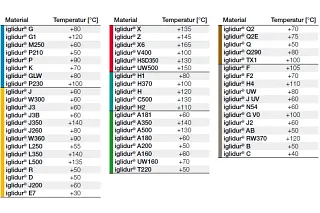
Temperatures at which securing our plain bearings is recommended
If the plain bearings are moved axially or axial forces occur, there is more opportunity for the bearing to lose press-fit. In these cases, axial securing of the bearing is necessary in addition to the press-fit. The adjacent table shows the temperature limit above which the plain bearings in the hole must be secured, even with low axial forces. The greater the forces, the more reasons to engage such a fastening.
Locating spigot of plain bearings
If the press-fit of the plain bearing is not sufficient, various options are available to secure plain bearings axially.
The most tried and tested methods are listed below:
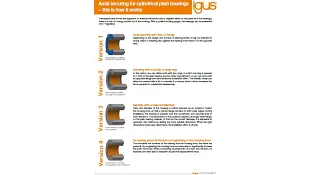
Fact sheet on locating spigot of the plain bearing
There are various methods for the axial securing of plain bearings. This fact sheet will tell you what they are and what they require.
Anti-rotation feature of plain bearings
In addition to the locating spigot, the anti-rotation feature is a frequent topic in design. Plain bearings are designed to be moved by the shaft while the bearing itself is fixed in the housing.
Metal or PTFE plain bearings require a firm fixing, as their sliding properties depend on the liner on the inner diameter. Plastic bearings are more resistant here, as the homogeneous material itself has good sliding properties. Nevertheless, even with plastic bearings, "turning" in the hole is undesirable, as housing bores are generally not optimised for friction.
Practical solutions for anti-rotation feature


Free iglidur plain bearing sample box
See the quality of our products for yourself. The iglidur plain bearing sample box contains:
✅ 39 iglidur plain bearings made from the most important materials
✅ Templates for finding the perfect material for your application
✅ iglidur bearing technology catalogue with information about our plain bearings


Standard or customised solutions?
We offer you both special parts and an extensive catalogue product range. Therefore, you don't always need a special part to secure your bearing position. To make your design work easier, you can also download CAD files from us free of charge.
If it has to be a special part, plastic plain bearings offer the greatest flexibility in component design thanks to their material properties and modern manufacturing processes. Production using 3D printing, machining or injection moulding offers you great freedom in design.