Change Language :
igus products without PTFE
As a manufacturer of industrial components made from high-performance polymers, we use a wide variety of materials. PTFE ensures low-friction dry operation and makes the use of lubricants superfluous. Thanks to the superior PFAS, some of our plastics become robust, more wear-resistant and more resistant to weathering, chemicals and extreme temperatures. However, PTFE and PFAS are regarded as "eternal chemicals", as both are difficult to break down in the environment and have a long service life. Substances of this type can be potentially harmful to the environment, humans and animals, which is why the EU is currently seeking to regulate or ban PFAS.
However, our development department has been working on alternatives to PTFE for some time now. Thanks to new formulations, extensive testing and adapted production processes, our product range now includes a wide range of materials and products that do not contain PTFE, such as the material iglidur JPF, which was named Product of the Year 2025 by plastic magazine. We are continuing our research into suitable substitutes for materials containing PTFE. Below we present our solutions and provide further details and background information on these materials and our products.

The most important points in brief
- Depending on the PTFE content, plastic products may be affected by a possible PFAS ban.
- Many igus materials do not contain PTFE, and no traces of the critical PFAS substances could be detected in other igus materials.*.
- If PTFE is not banned, igus materials are generally not affected.

igus materials that are PTFE-free and have been tested for harmful PFAS
The following igus materials do not contain PTFE and are therefore not affected by future PFAS regulations. They were also tested for the 96 PFAS substances considered critical for the environment and health according to the SQP M1227 test method (LC-MS/MS and GC-MS) and do not contain any substances > 0.1 per cent by mass. Excluded are substances from the group of fluoropolymers, which are not tested for.You can find a complete overview of our materials here.
Our PTFE-free material iglidur JPF was honoured by Kunststoff Magazin as Product of the Year 2025 in the Materials category.
iglidur materials that are PTFE-free and have been tested for harmful PFAS
igumid materials that are PTFE-free and have been tested for harmful PFAS
xirodur materials that are PTFE-free and have been tested for harmful PFAS


Note: The presence of ubiquitous traces of undesirable substances can never be ruled out. Since igus has no control over the use of the above materials and products, we assume no guarantee or liability, express or implied, in connection with the use of this information.
With in-house development and own test laboratory for PTFE and PFAS alternatives
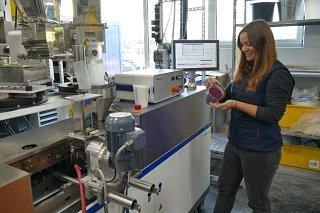
We have a very high level of vertical integration. To this end, we operate our own development department for materials, an in-house compounding department, a technical centre for process engineering tests and an extensive test laboratory for materials and products. On this basis, we have developed possible alternatives to PTFE and PFAS that are not more expensive and do not contain any problematic ingredients that could lead to a ban in the future. We have tested these alternatives in our test laboratory under real conditions for the changed material compositions and their possible effects on the specification of the materials.
The results speak for themselves. Compared to the original PTFE-containing materials, materials with substituted PTFE exhibit significantly better performance in terms of friction and wear behaviour. The already good wear rates are reduced by the new development of the PTFE substitution by an average of approx. 60%. Thanks to the clever design of the formulations, the other material properties remain almost the same in terms of temperature stability, mechanical strength and shrinkage behaviour. Thanks to new formulations, extensive testing and adapted production processes, we can now offer you a wide range of PTFE-free and PFAS-tested materials and products.

It is not easy to find materials with similar specifications. Nevertheless, we succeeded.
Dr-Ing. Magnus Orth
Head of Materials Development and Technical Centre at igus
From development: Major progress with PFAS and PTFE
How far along is igus with the topic of PFAS and PTFE?
Magnus Orth: "We are continuing to develop PTFE-free alternatives to our most successful PTFE-containing materials at full speed. The main focus here is on expanding our top five plain bearing materials to include variants without the fluorine additive. The aim is to develop PTFE-free variants with the same or better specifications than the PTFE-containing originals. In 2024, we already presented the iglidur JPF and iglidur WPF materials. These are PTFE-free versions of the highly versatile and proven iglidur J, as well as the iglidur W300, which is optimised primarily for somewhat higher loads and wear requirements. We have also developed a recipe for a PTFE-free iglidur F. Now, just in time for Hannover Messe 2025, we can announce a major breakthrough. We have made PTFE-free versions of the most successful iglidur material - iglidur G - and we can now also offer the high-temperature standard iglidur X as PTFE-free. With iglidur HPF, we also offer a version especially for use in liquid media."
What was the biggest challenge during development?
Magnus Orth: "For the widely used iglidur materials in particular, it is very difficult to ensure that the products offer the same performance in practice as the PTFE-containing versions. As these are used in an extremely wide range of applications with very different requirement profiles and the design of plain bearings - if it is to be truly accurate - is based on a great deal of experience and empiricism and is difficult to simulate theoretically due to the many influencing factors, the testing effort is considerable. Our well-equipped wear laboratory and our experience help us to do this. PTFE really comes into its own when it comes to chemical-resistant and temperature-resistant bearings. It is not easy to find materials with similar specifications. Nevertheless, we succeeded."
Which applications or users benefit in particular from the new PTFE-free plain bearing materials?
Magnus Orth: "The range is wide. Many manufacturers are currently looking for products that do not contain PTFE or even PFAS. In addition to these aspects, resistance to corrosive cleaning agents and high temperatures are also important in food processing. In the automotive sector, price pressure is particularly high, while many other factors often play a role in consumer products such as electrical appliances and the like. With almost 30 plain bearing materials without PTFE and more than 40 materials in which we can already exclude the 100 PFAS that are considered critical, we offer a wide range of solutions."
PFAS in focus: planned restrictions, challenges and solutions
What exactly are PFAS and why are they so popular in industry and the consumer sector? Why is there an impending EU-wide ban and what can companies do now?
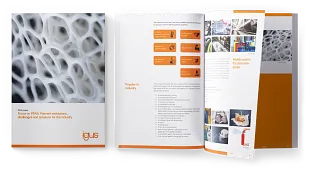
The white paper sheds light on these issues and shows how igus, as a plastics processor, can counter the planned restriction at an early stage and offer its customers alternatives and products tested for PFAS.
Background information on PFAS
What is PFAS?
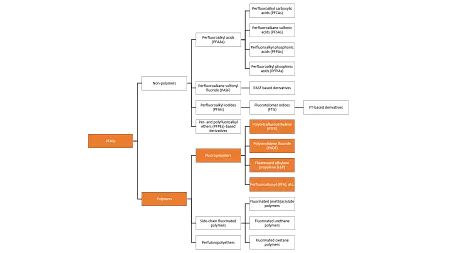
Per- and polyfluoroalkyl substances (PFAS) are industrial chemicals that are used in numerous industrial processes and consumer products due to their special technical specifications. They can be gaseous, liquid or solid and mostly consist of carbon and fluorine atoms. Apart from this, PFAS molecules can have completely different structures, which means that they can have many different specifications. As a group of substances, PFAS include many different compounds: according to the OECD database, more than 4,700, according to the EPA, more than 9,000 and according to the EU Commission, even more than 10,000. This shows that it is neither a clear nor a constant value - it is mostly based on estimates. With PFAS, a distinction is made between non-polymers and polymers, which in turn are subdivided into further substance groups:
- Non-polymers: In the subgroup of non-polymers, the compounds perfluorooctanoic acid (PFOA) and perfluorooctanesulfonic acid (PFOS) are the best analysed. Like many PFAS, these two compounds are persistent and can now be found in the environment, the food chain and in people. PFOA and PFOS have a proven negative impact on health. Together with PFHxs and PFNA, they account for 90% of the current PFAS load.
- Polymers: The subgroup of polymers includes fluoropolymers. Fluoropolymers consist of a carbon chain with directly attached fluorine atoms. This makes them so strong that they cannot break down into toxic substances. The only danger is the possible use of toxic additives during production in the form of emulsifiers. Fluoropolymers are used, for example, in coatings, seals and cable insulation. Fluoropolymers include polytetrafluoroethylene (PTFE) as well as other substances.
Current legal situation regarding PFAS (as of 25/09/2025).
EU: The use of PFOS has been largely banned since 2006 and that of PFOA since July 2020 - you can find our confirmation here. ECHA intends to consult on a draft statement on PFAS in spring 2026 (ECHA/NR/25/28). The European Chemicals Agency plans to consult on the draft statement of its Socio-Economic Analysis Committee (SEAC) on the proposed EU-wide restriction of per- and polyfluoroalkyl substances (PFAS) after the Committee's meeting in March 2026. The draft SEAC opinion on the PFAS restriction proposal will include an assessment of the socio-economic aspects, including the availability of alternative substances and technologies. The SEAC intends to adopt its draft statement at its meeting, which is provisionally scheduled for the first half of March 2026. The consultation will begin shortly after this meeting and will remain open for 60 days, during which stakeholders can provide feedback. Further information on PFAS can be found here at ECHA.
USA: The EPA has issued a final rule adding five PFAS substances to the list of over 170 PFAS substances. These must be reported as part of the Toxics Release Inventory (TRI), a central database for the public reporting of chemicals. Fluoropolymers are not included in the TRI list. You can also find out more about PFAS directly from the EPA here.
*The products were tested for the 96 PFAS substances considered critical for the environment and health according to test method SQP M1227 (LC-MS/MS and GC-MS) and do not contain any substances >0.1 per cent by mass. Excluded are substances from the group of fluoropolymers, which are not tested for.