Change Language :
iglidur pv values and coefficient of friction
In the case of plain bearings, there is one particularly important value: it is calculated by multiplying the specific load [p] with the surface speed [v]. The pv value can be regarded as a measuring unit of frictional heat and is therefore used for assessing a plain bearing's suitability. For this purpose, the actual pv value is compared with a predictable permitted pv value. The permitted pv value depends on shaft material, ambient heat and duty cycle.
Formula for the pv value
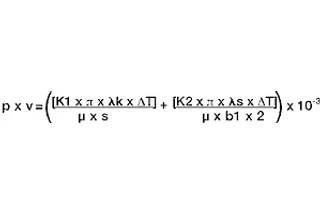
| In these equations: | |
|---|---|
| K1, K2 | Constant for heat dissipation (K1 = 0.5, K2 = 0.042) |
| s | Bearing wall thickness, mm |
| b1 | Bearing length [mm] |
| μ | Coefficient of friction |
| λs | Thermal conductivity of the shaft |
| λk | Thermal conductivity of the bearing |
| ΔT | (Ta - Tu) |
| Tu | Ambient temperature |
| Ta | Max. Application temperature |
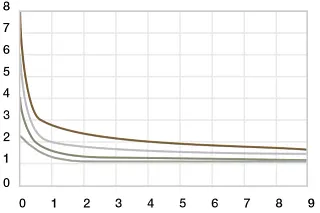
Correction factor of the permitted pv value due to intermittent operation
X-axis: correction factor
Y-axis: duty cycle [min]
Correction factor
The permitted pv value can be increased in intermittent operation if the bearing temperature does not reach the maximum at all due to the short run time. Tests have shown that this is the case with run times of less than 10 minutes. The shorter the run time, the lower the maximum bearing temperature reached.
An important factor is the ratio of duty cycle and pauses. It is obvious that long pauses contribute more to re-cooling. The different curves in the adjacent diagram represent the different ratios (three times means that the pause lasts three times longer than the run time).
Lubrication
Although iglidur plain bearings are designed for dry operation, they are compatible with standard oils and greases. One-time lubrication during the installation improves the start-up behaviour and the coefficient of friction, thus reducing frictional heat. Due to this effect, the permitted loads for plain bearings can be increased by lubrication. Numerous results from lubricated applications are available from tests. Please contact us if required. The table (see below) shows the correction factor for the pv value when lubricants are used.
| Lubrication | Correction factor |
|---|---|
| Dry operation | 1 |
| During installation | 1.3 |
| Continuous, grease | 2 |
| Continuous, water | 4 |
| Continuous, oil | 5 |
Thermal conductivity of shaft and housing materials
| Material | Thermal conductivity [W/m x k] |
|---|---|
| Steel | 46 |
| Aluminium | 204 |
| Grey cast iron | 58 |
| 304 stainless steel | 16 |
| Ceramics | 1.4 |
| Polymer | 0.24 |
Coefficient of friction
iglidur plain bearings are self-lubricating as they contain solid lubricants. These solid lubricants reduce the plain bearings' coefficient of friction and thus intensify their wear resistance. The coefficient of friction μ is proportional to the normal force and describes which force is needed to move a body in relation to another. Depending on whether an application is starting from a stationary position or the movement is in progress and needs to be maintained, a distinction is made between static and dynamic coefficient of friction.
Coefficient of friction and surfaces
The relationship between coefficient of friction and surface finish of the mating partners is shown here. It becomes clear that friction is composed of different factors. If the mating partner becomes too rough, abrasive processes play an important role. Small, interlocking irregularities in the surfaces must be removed. If the surfaces are too smooth, high adhesion occurs, i.e. the surfaces literally stick together. This requires higher forces, a consequence of the increased coefficient of friction. Stick-slip can be the result of a large difference between static and dynamic friction and a high adhesion tendency of glide surfaces. It is characterised by uneven running behaviour and can also lead to loud squeaking. You can avoid or eliminate such noises with rougher shafts. For applications that have a particular potential for stick-slip effects - slow movements, strong resonances of the housing - it is therefore important to make sure that the shafts offer the optimum roughness.
Consulting
I look forward to answering your questions

Shipping and consultation
In person
Monday to Friday: 8 am – 8 pm
Saturday: 8 am – 12 pm
Chat-Service
Monday to Friday: 8 am – 4 pm
WhatsApp-Service
Monday to Friday: 8 am – 4 pm