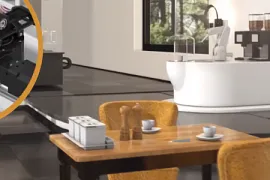
Eating out is becoming increasingly popular, but at the same time there is a shortage of staff who want to work in the catering industry. With its autonomous robot kitchen (ARK), the Canadian start-up RoboEatz has an answer to this problem. In a unique kitchen cell, a robot prepares a wide variety of hot and cold meals in the shortest possible time and with consistent quality. The cell can prepare up to 70 dishes in an hour, clean itself automatically and refill the 50 ingredient containers with solid and liquid contents. Following the construction of several prototypes and two years of testing, RoboEatz is now entering series production.
Problem
Control the ingredient containers, tip a weighed amount into the saucepan or mixer and deliver the ready-to-serve dish to the customer: there is a lot of movement in the kitchen cell. And to ensure that it runs smoothly, cleanly and safely, RoboEatz's designers were looking for energy supply systems, bearings and drive components that are suitable for food processing and do not require external lubrication. A long service life with simultaneous cost savings and the use of series parts with short delivery times were also required. It was also important to the RoboEatz founders to work with as few global suppliers as possible.
Solution
The developers drew on igus' many years of expertise in robotics and automation. A variety of motion plastics are used for the many different movements, which fulfil the requirements for durability, freedom from lubrication and cost savings. For example, dry-running igubal flange bearings and rod end bearings are responsible for the swivelling movement of the wok and the ingredient boxes and enable alignment compensation. iglidur MCM clip bearings also serve as shaft guides in sheet metal connections. The linear movements of the individual axes, for example on the containers, are realised with drylin linear technology. With the gripper, drylin SLW linear modules ensure a safe design; the gripper arm opens and closes by means of a counter-rotating spindle. With a rotation angle of 360° in the robot's first axis, an RBR energy supply system ensures a reliable energy and signal supply. And finally, a triflex energy chain with retraction system is mounted on the robot arm, which increases the service life of the cables in three-dimensional movement enormously.
Healthy fast food prepared and served by a cooking robot. Lubrication-free linear technology is used in the gripper.
A multi-axis triflex energy chain with a retraction system is installed on the robot.igubal spherical bearings are responsible for the pivoting movement of the ingredient boxes.
An RBR energy chain on the robot's rotary axis ensures the reliable supply of energy and signals.
Low Cost Automation for the catering industry
Lubrication-free lightweight components with a fast return on investment