Change Language :
What is the IP protection class?
Find out what is behind the numerical code
Electrical equipment can be exposed to a wide variety of conditions and must function flawlessly and reliably regardless of all external influences. Compared to a living room lamp, which is not exposed to rain showers inside the home, for example, a garden lamp must be designed and insulated specifically to withstand the weather. This adaptation takes place via protection classes.
Protection classes (International Protection Codes) clearly specify the influences from which a product is protected. Each category specifies the extent to which the unwanted ingress of foreign objects and moisture into the interior of a device is prevented. Protection against mechanical stress is also precisely defined in the IP specification.
What does the IP protection class mean?
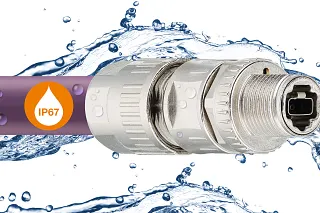
IP stands for International Protection or Ingress Protection. The IP specification, in combination with the following digits, gives precise information about the external influences against which a product is protected. In a plug-in connector, the housing (screw connection, seal, insertion), the locking mechanism and the mating connector provide protection against ingress. The contact point should be protected from external mechanical influences such as foreign objects, dust, accidental contact and the ingress of liquids in order to prevent, among other things, corrosion or contamination. Without this protection, the electrical conductivity of the contacts could be negatively affected, leading to production downtime or a risk to personnel.
The IP protection class can be found in a wide variety of areas, such as the following:
- Construction machinery
- Automotive sector
- Public transport
- Civil protection
- Defence technology
- Medical technology
- Food industry
- Event industry
How is the IP code structured?
The national and international standards DIN EN 60529 and ISO 20653 define these combinations of digits and the type of protection in the various IP protection classes.
The first digit stands for the degree of protection of the housing against contact and foreign bodies. The second digit stands for the degree of protection of the housing against moisture or ingress of water. If one of the two digits of the IP protection class does not have to be specified, an "X" is set instead of the digit.
| Meaning 1st digit | Meaning 2nd digit | IP |
|---|---|---|
| No protection | No protection | 00 |
| Protected against access with the back of the hand (solid foreign bodies with a diameter of 50mm or more | Protection against dripping water | 11 |
| Protected against access with a finger (solid foreign bodies with a diameter of 12.5mm or more) | Protection against vertically falling dripping water when the housing is tilted up to 15° | 22 |
| Protected against access with a tool (solid foreign objects with a diameter of 2.5mm or more) | Protection against vertically falling spray water up to 60° against the vertical | 33 |
| Protected against access with a wire (solid foreign objects with a diameter of 1.0mm or more) | Protection against splashing water on all sides | 44 |
| Complete protection against contact (against dust in damaging quantities) | Protection against water jets (nozzle) from any angle | 55 |
| Complete protection against contact (dust-tight) | Protection against strong water jets | 66 |
| Protection against temporary submersion | 7 | |
| Protection against permanent submersion | 8 | |
| Protection against water during high pressure/steam jet cleaning | 9 |
Which IP protection class is suitable for which application?
When assembling cables,igus uses plug-in connectors with different protection classes in various areas, depending on the application. Below, we would like to provide you with an overview of which protection classes are suitable for which application areas.
Protection classes IP2X & IP20
Plug-in connectors with IP2X or IP20 protection classes are frequently used in office spaces or in protected, enclosed areas such as control cabinets, terminal boxes, control panels, etc. Here, a relatively low IP protection class is required, as there are no special environmental conditions from which the connector needs to be protected. The same applies to the machine tool industry, where switchgear that protects against external influences is used, meaning a high protection class for the plug-in connector is not required.
Protection class IP55 and upwards
Connectors with protection class IP55 and higher already offer a high level of protection against the ingress of various media. This protection class is therefore particularly suitable for offshore applications, e.g. cranes in ports. Plug-in connectors with protection class IP55 or higher are also used in the construction industry, where they must withstand adverse weather and environmental conditions. Depending on the type of application and the environment, the appropriate connector with the corresponding protection class should be selected.
Protection class IP65
If a plug-in connector has protection class IP65, it provides complete protection against accidental contact. Dust cannot penetrate and the connector is protected against water jets from any direction. IP65 is particularly useful when moving parts need to be protected, such as motors or gearboxes.
Visit our plug-in connector shop and find the right connector for your application.
Consulting
I look forward to answering your questions

Markus Hüffel+49 2203 9649 347Write e-mail
Shipping and consultation
In person
Monday to Friday: 8 am – 8 pm
Saturday: 8 am – 12 pm
Chat-Service
Monday to Friday: 8 am – 4 pm
WhatsApp-Service
Monday to Friday: 8 am – 4 pm