Change Language :
Classification of chainflex® cables
To make it easier for you to select a cable, we have classified all chainflex® types according to the criteria "stress, travel, oil resistance and torsion". The higher the number, the better the cable.
Example: You are looking for a cable that is suitable for the highest mechanical stress. The travel should be up to 100m for unsupported and gliding applications. It should also fulfil the oil resistance requirements of DIN EN 50363-10-2. The cable should not be specially designed for torsion applications.
Select from the classification overview:
Stress: 6 Travel: 5 Oil resistance: 3 Torsion: 1
This results in the rating of the cable - in this case "Class 6.5.3.1", which you can also see on the respective product pages.
| Load | Travel | Oil resistance | Torsion |
|---|---|---|---|
| from 1 to 7 | 1 to 6 | 1 to 4 | 1 to 4 |
| Load | low | 1 | 2 | 3 | 4 | 5 | 6 | 7 | highest |
| Travel | unsupported | 1 | 2 | 3 | 4 | 5 | 6 | 400m + | |
| Oil resistance | none | 1 | 2 | 3 | 4 | highest | |||
| Torsion | none | 1 | 2 | 3 | 4 | ±360°/m |
The chainflex® class is composed of 4 parts:
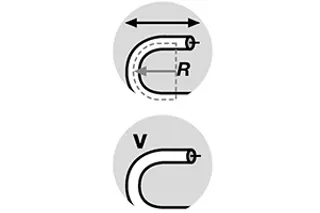
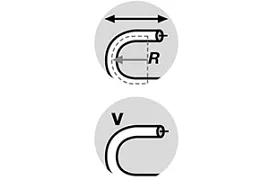
Stress (R and V)
1 to 7
- 1: Flexible cables
- 2: Highly flexible cables
- 3: Chain-compatible cables without special construction (e.g. cores wound in layers) for use in e-chains®.
- 4: Cables with special construction for continuous movement in e-chains®, medium stress, radii from 7.5 x d, speed up to 3m/s
- 5: Cables for continuous movement in e-chains®, high stress, radii from 6.8 x d, speed up to 10m/s
- 6: Cables for continuous movement in e-chains®, maximum stress, radii from 5 x d, speed up to 10m/s
- 7: Cables for continuous movement in e-chains®, maximum stress with the smallest radii, indoor and outdoor applications, radii from 4 x d, speed up to 10m/s and more
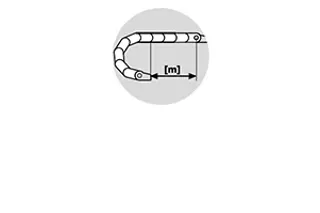
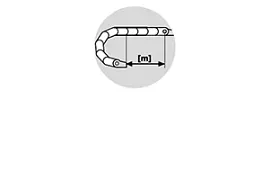
Travel
1 to 6
- 1: unsupported
- 2: Travel up to 10m
- 3: Travel up to 20m
- 4: Travel up to 50m
- 5: Travel up to 100m
- 6: Travel up to 400m and more
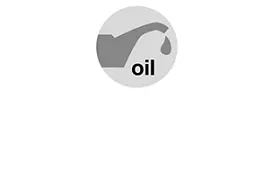
Oil resistance
1 to 4
- 1: No oil resistance
- 2: Oil-resistant (in accordance with DIN EN 50363-4-1)
- 3: Oil-resistant (in accordance with DIN EN 50363-10-2)
- 4: Oil-resistant (in accordance with DIN EN 60811-2-1, resistant to organic oils (tested in accordance with VDMA 24568 with Plantocut 8 S-MB by DEA)
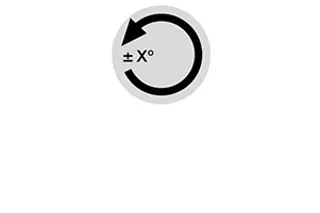
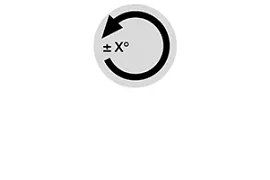
Torsion
1 to 4
- 1: no torsion
- 2: ± 90°, with 1m cable length
- 3: ± 180°, with 1m cable length
- 4: ± 360°, with 1m cable length
In theory the following classes would be possible: lowest "Class 1.1.1.1", highest "Class 7.6.4.3"
In theory the following classes would be possible: lowest "Class 1.1.1.1", highest "Class 7.6.4.3"
What does the chainflex® "Class"(ification) mean?
With chainflex® cables, igus® has now been offering cables for continuously moving use in e-chains® for over 25 years, which are simply only good for one thing:
Safe operation.
In all e-chain® applications, the chainflex® cables must fulfil demanding requirements, such as very small bend radii, a high number of cycles, small installation spaces and a wide variety of chemical influences and dynamic parameters.
igus® carries out basic qualification of cables according to igus® standards in its own technical centre and test laboratory. These chainflex® qualification standards include test programmes that ultimately lead to the igus® "Class".

Consulting
I look forward to answering your questions

Nils Jäger+49 2203 9649 9823Write e-mail
Shipping and consultation
In person
Monday to Friday: 8 am – 8 pm
Saturday: 8 am – 12 pm
Chat-Service
Monday to Friday: 8 am – 4 pm
WhatsApp-Service
Monday to Friday: 8 am – 4 pm