Change Language :
Servo vs. stepper motors
Servo motor vs. stepper motor: How do I choose the right one?
In engineering applications that require precise motion control, both servo motors and stepper motors are popular solutions. Both offer unique advantages that are suitable for different tasks. Choosing the right type of motor for your project is critical to ensure optimal performance and efficiency. In this article, we discuss the technical differences, control mechanisms and practical applications of the two motors to help you decide which one is best suited to your needs.
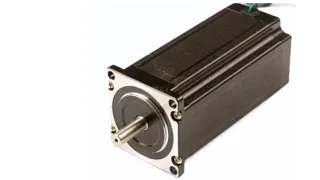
What is a servo motor?
A servo motor is a closed-loop control system that incorporates feedback to achieve precise positioning, speed, and torque control. A servo motor generally uses a high-resolution encoder, such as an optical or magnetic rotary encoder, to measure the actual position of the motor shaft and send this data back to a control system circuit. This allows for real-time adjustments, ensuring that accuracy is maintained even with fluctuating loads or external interference.
Servo motors can achieve high speeds and deliver considerable torque. Thanks to the closed control system, servo motors are capable of maintaining high torque even at low speeds. This is particularly advantageous for applications that require constant power output, such as in industrial robotics and CNC machines. Servo motors offer precise control and adaptability for multi-axis movements.
Technical specifications:
- Control method: Pulse width modulation (PWM) signals, often coupled with PID controllers, control the motor position and speed
- Feedback system: Uses encoders or resolvers for position feedback
- Torque characteristics: Excellent torque across the entire speed range, high torque at low speeds
- Applications: Robotics, CNC machines, automation systems with variable loads
Benefits:
- High accuracy: Servo motors offer exceptional precision and repeatability, making them perfect for tasks that require precise positioning.
- Speed and torque control: The closed system allows servo motors to maintain strong speeds and provide different torque levels, even under changing load conditions.
- Lower heat generation: Servo motors are more efficient compared to stepper motors, resulting in less heat dissipation during operation.
Restrictions:
- High costs: Servo motors are generally more expensive than stepper motors, mainly due to the additional feedback devices and more complex control systems.
- Complex control system: The configuration and adjustment of a servo motor's control system parameters can be difficult and requires expertise.
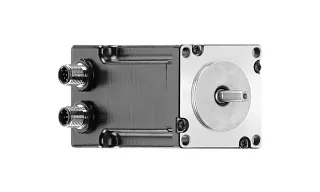
What is a stepper motor?
Stepper motors are open-loop control systems that use magnetic fields generated by multiple coils to rotate the rotor in discrete steps, typically measured in degrees per step. They are controlled by sending pulses through these coils in a specific sequence. Each pulse moves the rotor by a fixed angle, achieving predictable motion without feedback.
Stepper motors are suitable for applications in which precision and repeatability are crucial, but high torques and complex feedback systems are not required. The stepper system mechanism limits the torque at higher speeds. Stepper motors can also have problems with loads such as resonance and step losses. Despite these limitations, they are ideal for applications requiring precise incremental motion, such as 3D printing or X-Y plotter control systems.
Technical specifications:
- Control method: Pulse signals control the motor's step sequence; microsteps can be used for smoother motion
- Feedback system: Generally without feedback (open loop); closed-loop versions are less common
- Torque characteristics: High holding torque at low speeds, but decreasing torque with increasing speed
- Applications: 3D printers, laser cutters and other applications with low loads and high precision
Benefits:
- Cost-effectiveness: Stepper motors are more cost-effective than servo motors, making them popular for budget-conscious projects.
- Simple control system: The open loop simplifies the control system of stepper motors, which can be easily implemented without complex control algorithms.
- Holding torque: Stepper motors can hold a position without the need for a continuous power supply, which is advantageous for static holding applications.
Restrictions:
- Limited performance at high speeds: Stepper motors can become inefficient at higher speeds due to resonance, which reduces their performance in high-speed applications.
- Lower accuracy: Due to step losses, stepper motors may experience positioning errors under dynamic load conditions.
Differences in the number of poles between servo motors and stepper motors
The number of poles is a crucial differentiating feature between servo motors and stepper motors and directly influences their control and performance characteristics.
- Stepper motors: These usually have a high number of poles, often between 50 and 100 or more. The high number of poles allows for finer incremental steps.
- Servo motors: Compared to this, servo motors usually have fewer poles, often between 4 and 12. Due to the lower number of poles, they are more dependent on electronic control mechanisms and feedback systems to achieve smooth movement.
Impact of number of poles on applications
The high number of poles of stepper motors is ideal for tasks requiring low speeds and high precision, while the low number of poles of servo motors enables efficient performance at higher speeds.
Comparison of efficiency and reliability
Servo motors offer high efficiency over a wide speed range thanks to their closed-loop control system. They are ideal for applications where reliability and adaptability are crucial. Stepper motors, on the other hand, are cost-effective and mechanically simpler, but can become inefficient at high speeds due to decreasing torque effect.
Control accuracy: Encoder feedback vs. open-control loop
While servo motors use high-resolution encoders that provide real-time position and speed data, stepper motors have no integrated feedback. This makes stepper motors susceptible to position errors under variable loads or at high speeds
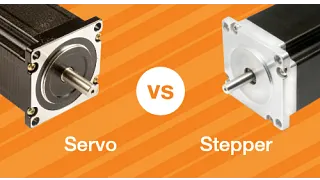
Stepper motor vs. servo motor: how to choose the right motor
Things to consider:
- Precision requirements: Does your application require a high level of precision and accuracy? Then a servo motor is the better choice.
- Budget constraints: If costs play a major role and moderate precision is sufficient, a stepper motor may be suitable.
- Complexity of control: If your team lacks experience with complex control algorithms, the stepper motor offers simpler implementation.
Conclusion
The choice between a servo motor and a stepper motor heavily depends on the specific requirements of your application. Servo motors offer superior precision, speed and torque control. However, they are more expensive and require advanced expertise. Stepper motors are a cost-effective and easy-to-implement alternative, but with limitations in terms of speed and accuracy. By carefully analysing your project needs, you can make the right decision and achieve optimal results.
Frequently asked questions:
Stepper motors usually operate in an open-loop system: the control system sends a command to move a certain number of steps. Generally, there is no feedback to confirm the actual position. Servo motors, on the other hand, use a closed-loop system with a feedback device. The control system continuously monitors the actual position and speed of the motor and adjusts the current to correct any deviations, thus ensuring high accuracy.
Stepper motors produce high torque at low speeds, but their torque decreases significantly as the speed increases (typically above 1,000rpm). Servo motors, on the other hand, maintain a high and consistent torque over a wide speed range and often achieve significantly higher maximum speeds (above 2,000rpm). Servos can also provide momentary peak torque for fast acceleration.
Servo motors generally offer higher accuracy and no risk of positional loss because their control loop continuously checks and corrects the position using feedback from the encoder. Stepper motors can "lose steps" in a standard open-loop configuration under excessive load or high acceleration, resulting in positioning errors without the system noticing.
Stepper motor systems are typically more cost-effective due to their simpler design and open-loop control, which does not require an expensive encoder or complex drive. Servo motor systems are generally more expensive because they require an encoder and a more complex drive and often use more expensive components such as rare earth magnets.
A stepper motor is ideal for applications that require:
- Low to moderate speed (below 1,000rpm).
- High holding torque at standstill.
- Precise, repeatable positioning with predictable and strong load.
- Simplicity, low cost and minimal tuning effort.
A servo motor is better suited to applications that require the following:
- High speed and high acceleration/braking performance.
- Operation under variable or unpredictable loads.
- Maximum efficiency and high torque over a wide speed range.
- Maximum positioning accuracy and dynamic response.
Servo motors are generally more energy efficient, as their closed control loop only draws the current required to move the load or maintain the commanded position. Stepper motors, on the other hand, continuously consume current, even when stationary, which leads to higher energy consumption and more heat generation.


