Change Language :
What is PROFINET? Everything you need to know
PROFINET (Process Field Network) is an open industrial Ethernet communication protocol that enables real-time communication between control systems and devices in industrial automation. It is a protocol similar to PROFIBUS, with PROFIBUS based on a fieldbus protocol, while PROFINET uses Ethernet. Read on to find out more about PROFINET, its functions, and why it is such a valuable solution for industrial automation.

History of PROFINET
The first version of PROFINET, PROFINET CBA (Component Based Automation), was introduced in 2001 and discontinued in 2014. This initial version didn't catch on, unlike its successor, PROFINET IO (Input Output).
PROFINET IO was introduced in 2003 and forms the basis for subsequent PROFINET updates. One of the most significant updates occurred in 2019 when Time-Sensitive Networking (TSN) was added.
As PROFINET is an open protocol, manufacturers worldwide have been able to develop PROFINET-enabled devices such as robots, PLCs, IOs and more.
How does PROFINET work?
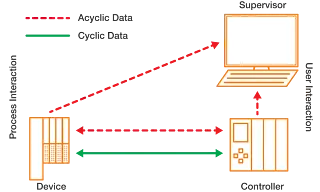
PROFINET systems comprise three components: supervisors, control systems and devices.
- IO supervisors: Supervisors are used to configure PROFINET systems, define device parameters and perform diagnostics. Supervisors do not have to remain connected to the network permanently if they are not needed.
- IO controllers: IO controllers are typically programmable logic controllers (PLC) that manage the automation program. They control IO devices and collect the data sent back by these devices.
- IO devices: IO devices are field devices that cyclically exchange data with one or more IO controllers.
Each of the above components works together via an Ethernet network to reliably exchange real-time data, utilising a wide range of communication standards.
A PROFINET network requires at least one IO controller and one IO device. IO supervisors can be used temporarily for setting up and diagnosing IO devices, but are not crucial for the functioning of a PROFINET network.
PROFINET communication standards
When it comes to the communication standards used in PROFINET networks, there are three main standards to understand: TCP/IP or UDP/IP, PROFINET Real-Time (RT) and PROFINET Isochronous Real-Time (IRT).
- TCP/IP or UDP/IP: These protocols are used in applications that are not time-critical, such as diagnostics, configurations and parameterisations. The reason for this is the additional jitter and latency that occurs with IP-based communication.
- PROFINET RT: PROFINET RT is by far the most commonly used communication protocol for PROFINET networks. In essence, PROFINET RT skips the network and transport layers during data transfer, which significantly reduces the time required. PROFINET RT can achieve cycle times between 250µs and 512ms.
- PROFINET IRT: PROFINET IRT goes a step beyond PROFINET RT by minimising jitter in applications with high data traffic. IRT achieves cycle times of 31.25µs and only one µs jitter. It is most commonly used in material processing machinery (ceramic, wood or glass), plastic injection moulding machinery and packaging machinery.
Benefits of using PROFINET
PROFINET offers a number of advantages that set it apart from similar protocols such as PROFIBUS. These include scalability, flexibility and integration with other systems.
Scalability: Due to the use of an Ethernet physical layer, PROFINET can be used in various topologies, including star, ring and tree structures. Peer-to-peer and IO communication are also possible, making it easy to adapt PROFINET networks to the needs of your company.
Flexibility: Optional functions such as redundancies, time stamps, IRT and diagnostic alarms make PROFINET an extremely flexible and modular system. The specific requirements of a company can be met with PROFINET, all using industrial Ethernet standards.
Integration with other systems: As PROFINET uses industrial Ethernet, it is compatible with standard Ethernet and can provide TCP/IP functions if required. Integration with standard Ethernet is easy and allows global processes to be interconnected via PROFINET.
Integration of PROFINET and IIoT
PROFINET is an Ethernet-based protocol with open standards and is therefore ideal for integration into the Industrial Internet of Things (IIoT). All data has already been collected; the integration of the IIoT simply makes it possible to track trends and draw conclusions from this data.
Integration of PROFINET networks into the IIoT can eliminate unscheduled machine downtime by alerting operators to performance parameters outside specified benchmarks at an early stage. This enables operators to plan maintenance work in advance and minimise the downtime required, while avoiding unexpected outages or stoppages.
Conclusion
When it comes to user-friendly solutions for factory automation, PROFINET is the undisputed market leader. Lightning-fast data transfer rates, exceptional reliability, and comprehensive functionality work together to create a protocol that will last for decades.
Looking for an even more convenient solution?
We recommend choosing a maintenance-free drylin linear axis with an igus motor. Many motor parameters are adopted automatically by the D1. This saves you from configuring the motor at all.
Why do I need the D1?
Among other things, the D1 motor control system is suitable for electric operation:
- of a single-axis system
- of linear robot structures (line robot/flat linear robot/room linear robot)
- of a delta robot