Change Language :
iglidur® H - Material data
The most important specifications at a glance
iglidur H is a fibre-reinforced thermoplastic material that was specially developed for applications in high humidity or under water. Plain bearings made from iglidur H can be used completely free of lubrication; in wet applications, the surrounding media acts as additional lubricant.
| Descriptive technical specifications | ||
|---|---|---|
| Wear resistance at +23°C | - 🟧 🟧 ⬜️ ⬜️ ⬜️ + | More information on wear resistance |
| Wear resistance at +90°C | - 🟧 🟧 ⬜️ ⬜️ ⬜️ + | |
| Wear resistance at +150°C | - 🟧 🟧 🟧 ⬜️ ⬜️ + | |
| Slide property | - 🟧 🟧 🟧 ⬜️ ⬜️ + | Coefficient of friction, dynamic, against steel: µ 0.07 - 0.20 |
| Wear resistance under water | - 🟧 🟧 🟧 🟧 ⬜️ + | |
| Media resistance | - 🟧 🟧 🟧 🟧 🟧 + | More information on media resistance |
| Resistant to edge pressures | - 🟧 🟧 ⬜️ ⬜️ ⬜️ + | |
| Resistant to shock and impact loads | - 🟧 🟧 ⬜️ ⬜️ ⬜️ + | |
| Dirt resistance | - 🟧 🟧 🟧 ⬜️ ⬜️ + |
Temperatures
With increasing temperatures, the compressive strength of iglidur H plain bearings decreases. The temperatures prevailing in the bearing system also have an influence on the wear. Additional securing is required at temperatures higher than +120°C.
Temperatures, coefficient of thermal expansion
| Min. application temperature | Upper application temperature, long-term | Upper application temperature, short-term | In addition secure axially from |
|---|---|---|---|
| -40°C | +200°C | +240°C | +120°C |
Permissible surface speeds
The maximum permitted surface speed is dependent on whether the temperature at the bearing point becomes too high or not. iglidur H is suitable for maximum surface speeds of 1m/s (rotating) and 3m/s (linear) in dry operation. Linear movements enable higher surface speeds, as a large area of the shaft contributes to the cooling.
Surface speeds of various iglidur materials
| Maximum surface speeds [m/s] | Rotating | Oscillating | Linear |
|---|---|---|---|
| Long-term | 1.0 | 0.7 | 3.0 |
| Short-term | 1.5 | 1.1 | 4.0 |
Permissible pv values
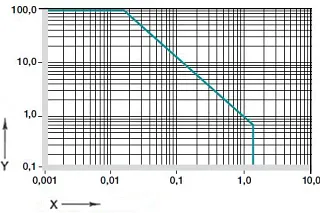
Diagram 01: Permissible pv values for iglidur H plain bearing with a wall thickness of 1mm in dry operation against a steel shaft at +20°C, mounted in a steel housing
X = Surface speed [m/s]
Y = Load [MPa]
Mechanical properties
The maximum recommended surface pressure is a mechanical material parameter. No conclusions regarding the tribological properties can be drawn from this. With increasing temperatures, the compressive strength of iglidur H plain bearings decreases. Diagram 02 shows this inverse relationship. Diagram 03 shows the elastic deformation of iglidur H at radial loads. At the maximum recommended surface pressure of 90MPa the deformation is about 2.5%.


Friction and wear
The coefficient of friction changes with increasing load, as does the wear resistance.
Interestingly, the coefficient of friction µ lowers slightly with the increase of surface speed at constant load (see diagram 04 and 05).
Coefficient of friction against steel (Ra = 1µm, 50HRC):
| iglidur H | dry | Greases | Oil | Water |
|---|---|---|---|---|
| Coefficient of friction μ | 0.07-0.20 | 0.09 | 0.04 | 0.04 |


Shaft materials
Diagram 06 and 07 display the results of tests with different shaft materials executed with plain bearings made of iglidur H. The iglidur H plain bearings give different results when used in rotating and pivoting applications on different shaft materials. The Cf53 and HR carbon steel shafts give the best wear values in rotating applications, whereas the 304 stainless steel shafts (which are not so good for rotation) give the best results in pivoting applications. Hard-chromed shafts only give an advantage at low pressures when used with iglidur H bearings.


Chemical resistance
iglidur H plain bearings have good resistance to chemicals. Therefore, even aggressive chemicals can act as a lubricant. iglidur H plain bearings are non-resistant to hot, oxidising acids.
All data at room temperature [+20 °C], + resistant 0 conditionally resistant - non-resistant
| Chemicals | Resistance |
|---|---|
| Alcohols | + |
| Greases, oils without additives | + |
| Hydrocarbons | + |
| Fuels | + |
| Strong alkalines | + |
| Strong acids | + to - |
| Diluted alkalines | + |
| Diluted acids | + up to 0 |
Moisture absorption

Installation tolerances
iglidur H plain bearings are standard bearings for shafts with h-tolerance (recommended minimum h9). The bearings are designed for press-fit into a housing machined to a H7 tolerance. After being assembled into a nominal size housing, in standard cases the inner diameter automatically adjusts to the F10 tolerances. For particular dimensions the tolerance differs depending on the wall thickness (please see product range table).
Important tolerances according to ISO 3547-1 after press-fit:
| Diameter d1 [mm] | Housing H7 [mm] | iglidur H plain bearing F10 [mm] | Shaft h9 [mm] |
|---|---|---|---|
| up to 3 | +0.000 +0.010 | +0.006 +0.046 | -0.025 +0.000 |
| > 3 up to 6 | +0.000 +0.012 | +0.010 +0.058 | -0.030 +0.000 |
| > 6 up to 10 | +0.000 +0.015 | +0.013 +0.071 | -0.036 +0.000 |
| > 10 up to 18 | +0.000 +0.018 | +0.016 +0.086 | -0.043 +0.000 |
| > 18 up to 30 | +0.000 +0.021 | +0.020 +0.104 | -0.052 +0.000 |
| > 30 up to 50 | +0.000 +0.025 | +0.025 +0.125 | -0.062 +0.000 |
| >50 to 80 | +0.000 +0.030 | +0.030 +0.150 | -0.074 +0.000 |
| >80 to 120 | +0.000 +0.035 | +0.036 +0.176 | -0.087 +0.000 |
| > 120 up to 180 | +0.000 +0.040 | +0.043 +0.203 | +0.000 +0.100 |
✓38 plastic bearings made of the most important iglidur materials
✓ iglidur H plain bearings included
✓ Templates for finding the perfect material for your application
✓ iglidur bearing technology catalogue

Buy iglidur H products in the online shop
- Large selection of shapes and materials
- Available in 24 hours
- No minimum order
- No minimum order quantity
Typical application areas


Consulting
I look forward to answering your questions

Shipping and consultation
In person
Monday to Friday: 8 am – 8 pm
Saturday: 8 am – 12 pm
Chat-Service
Monday to Friday: 8 am – 4 pm
WhatsApp-Service
Monday to Friday: 8 am – 4 pm